

We’ve been taught to treat stress like the villain of modern life, eliminate it, avoid it, “Manage” it before it ruins your health.
But here’s the uncomfortable, freeing truth: Stress isn’t the enemy. Stagnation is.
Resilience isn’t something you have or lack. It’s a loop your nervous system learns to run again and again. Let’s break it down.
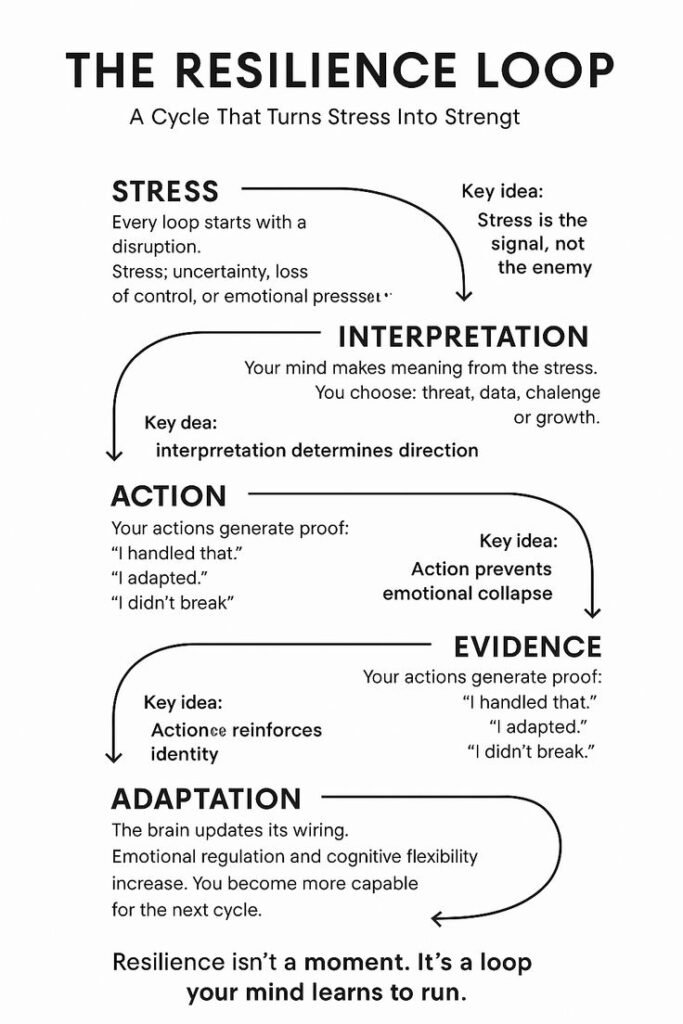
Step 1: Stress – The Signal, Not the Threat
Every resilience loop begins with disruption.
A missed deadline. An unexpected diagnosis. A relationship wobble. A body that suddenly says, “Hey, slow down.”
Stress is simply your nervous system saying: “Something changed. Pay attention.”
Your heart rate rises, your breath shortens, your focus narrows. And this is not failure, this is information. Problem isn’t stress itself, it’s what we do next.
Step 2: Interpretation – Where the Real Damage (or Growth) Happens
The same stressor can produce wildly different outcomes depending on interpretation.
Your mind asks: Is this a threat or is this data? Is this danger or a challenge?
Science backs this up. Studies on stress appraisal show that when stress is interpreted as manageable, the body produces a more adaptive physiological response with less inflammation, better recovery, improved performance. Same stress. Different story. This is where resilience quietly begins.
Step 3: Action – Small Moves, Big Wins
Action doesn’t mean fixing everything. It means doing something instead of freezing. A breath, a walk, asking for help, saying no, showing up imperfectly.
Action tells your brain:
“I didn’t collapse.”
“I adapted.”
“I survived this.”
And the nervous system loves proof. Action interrupts emotional spirals faster than positive thinking ever will.
Step 4: Evidence Your Brain Collects Receipts
Your brain is constantly asking: “What kind of person am I?”
Every time you act under stress, you generate evidence.
Real data: “I handled that conversation.” “I rested when I needed to.” “I didn’t abandon myself.”
This evidence quietly reshapes identity from fragile to capable.
Step 5: Adaptation – Where Healing Happens
This is the part most wellness conversations skip.
After stress + interpretation + action, the brain rewires.
Neuroplasticity increases, emotional regulation improves, cognitive flexibility expands. You don’t just feel better, you become better equipped for the next stressor. That’s resilience.
Why This Matters
Chronic stress without resolution keeps the body stuck in survival mode:
- Elevated cortisol
- Increased inflammation
- Dysregulated heart rate variability
But completed stress cycles, stress followed by adaptive action support:
- Autonomic balance
- Cardiovascular resilience
- Emotional regulation that protects the heart
Your heart doesn’t need a stress-free life. It needs a stress-literate one.
The Truth Nobody Tells You
Resilience isn’t built in calm moments, it’s built when life shakes you and you don’t disappear. And no, you don’t need a “stronger mindset.”
You need:
- Better interpretation
- Smaller actions
- More self-trust
Resilience isn’t a moment of strength, it’s a loop your body learns to run. Again and again.
And every time you complete the loop your heart, your brain, and your nervous system get a little stronger.